NACC ACCREDITED PROGRAM
NACC EARLY CHILDHOOD ASSISTANT
DIPLOMA PROGRAM
The NACC Early Childhood Assistant program at DataWiz College prepares individuals for roles as assistants in daycares or early learning centers by providing essential knowledge, skills, and practical experience. The program offers students an understanding of the duties of an early childhood assistant and hands-on opportunities to carry out these responsibilities.
The Early Childhood Assistant program at DataWiz College in Toronto delivers a career-focused curriculum aligned with Ontario's childcare regulations. Whether you're aiming to start working quickly or build a long-term career in early education, the program equips students with essential knowledge in child development, communication skills, health and safety, curriculum planning, and related areas.
Created with adult learners and newcomers to Canada in mind, the program combines instructor-led classroom instruction with hands-on, in-person practicum placements. Graduates earn a recognized diploma that prepares them for employment in child care centres, preschools, and early learning environments across Ontario.

25
Weeks Program
Why Early Childhood Assistant
Program At DataWiz
College Is Your Smartest
Career Move
Program At DataWiz
College Is Your Smartest
Career Move
PROGRAM OVERVIEW
Total Program Hours
675 Hours
Courses
14 Courses in Total
Credentials
Accredited Diploma awarded
Delivery Mode
Online/ Hybrid (Instructor-Led)
In-person
Online - synchronous
PROGRAM STRUCTURE
Structured hours that combine classroom theory, practical skills, and supervised placements.
| Courses | Types | Hours |
|---|---|---|
| 1-14 | Theory + Practicum | 1000 |
| Theory | Classroom Learning | 675 |
| Practicum Placement 1 | Infant & Toddler | 125 |
| Practicum Placement 2 | Preschool | 200 |
| Total Program Hours: | 1000 | |

WHAT YOU WILL LEARN
The Early Childhood Assistant Diploma Program prepares students with the knowledge and hands-on skills needed for a successful career in early childhood education.
Work directly with children and families and build meaningful connections during early development.
Support children's social-emotional growth and resilience through developmentally appropriate practices.
Apply child development, communication, health and safety, and curriculum planning knowledge in class and practicum.
Gain supervised practical experience that builds confidence, professionalism, and job readiness.
ECA PROGRAM'S COURSES
14 comprehensive modules plus practicum components aligned with NACC ECA expectations.
1 - 90 Hours
Foundations of Early Childhood Education
This course introduces students to early child care and education through the historical roots of early learning and the contemporary approach to play-based care. Students examine theoretical approaches to working with young children and families in diverse communities, explore dimensions of high-quality childcare, review current legislation, and study the early learning framework.
2 - 45 Hours
Communications
This required course introduces professional interpersonal communication skills that are expanded and practiced in later courses. Students explore professional communication, reflective practice, and collaboration, and build skills needed to establish inclusive relationships within the ECE community.
3 - 45 Hours
Observation Skills
Students develop a comprehensive understanding of child development from conception through early childhood. The course explores developmental theories and focuses on physical, cognitive, and socio-emotional domains, linking these to developmentally appropriate practice that supports children's growth.
4 - 90 Hours
Infant and Childhood Development
This course introduces the role of the observer and different approaches to observing development. Students examine ethical standards for observation and documentation, and practice writing concise, accurate, objective observations using multiple observation tools.
5 - 45 Hours
Health and Safety and Nutrition
Covers health, safety, and nutritional needs of children and educators. Students learn how safe learning environments promote well-being, and study health promotion, illness prevention, occupational health and safety, and the Child Care and Early Years Act, 2014.
6 - 45 Hours
Child, Family and Community
Students study ways to form positive partnerships between families and educators. The course includes strategies for family involvement, communication with parents, parent education, and child-rearing issues while building inclusive, welcoming, anti-bias practices across diverse family structures, cultures, socioeconomic backgrounds, religions, and ethnicities.
8 - 45 Hours
Introduction to Sociology
Introduces sociological inquiry, concepts, research, and theories and applies them to daily life in Canadian society. Students explore family, ethnicity, class, community, school, childcare, social change, women's issues, multiculturalism, immigration, and other social institutions.
9 - 45 Hours
Play-Based Early Learning Strategies
Students explore foundations of play-based curriculum for inclusive and holistic development in early learning environments. The course reviews curriculum framework-guided planning and strategies for creative arts and sensory experiences, preparing students for practicum and professional practice.
10 - 45 Hours
Language and Literacy
Provides theory related to language acquisition in early childhood and teaching techniques in play-based curriculum. Students examine the importance of social, cultural, and linguistic diversity in early experiences and apply language development theory to program planning and literacy-rich practice.
11 - 45 Hours
Introduction to Psychology
An overview of psychological theories and empirical studies, including research methodologies and factors influencing behaviour and experience. Students study human development, normal and abnormal behaviour, social psychology, learning, perception, and psychological measurement.
12 - 45 Hours
Guiding Children's Behavior
Explores current research and approaches for guiding children's behaviour in early childhood programs. Guidance and discipline are examined through child development and developmentally appropriate practice, including diversity, vulnerabilities, and behavioural analysis.
13 - 45 Hours
Creating Inclusive Programs
Students use a developmental approach to typical and atypical development and adapt curriculum to meet diverse needs. The course focuses on designing inclusive, meaningful, responsive play-based environments and using tools such as Individualized Intervention Plans.
14 - 45 Hours
Special Needs
Develops understanding of adapting curriculum for children with disabilities and special needs to support children and families effectively. Emphasis is placed on educator roles, current legislation, trends, and evidence-based practice.
PROGRAM PRACTICUM PLACEMENT
Practicum 1 (125 Hours)
The practicum placement is a vital part of your learning journey, giving you the opportunity to connect classroom theory with real-world childcare experience. During Practicum 1, students actively apply what they have learned in a professional setting while developing confidence, self-awareness, and essential workplace skills.
This hands-on experience allows students to work closely with children, families, and childcare professionals, building strong communication skills and professional attitudes required in early learning environments. All students gain valuable exposure to working with infants or toddlers, preschoolers, and school-age children, ensuring a well-rounded foundation for a successful career in early childhood education.
Practicum 2 - Preschool (200 Hours)
Practicum 2 offers students an opportunity to apply classroom learning in a real preschool setting, such as a licensed daycare, early learning centre, or kindergarten classroom. Students gain hands-on experience working directly with children while developing communication, classroom management, and child development skills.
Faculty supervisors observe student performance, provide guidance, and offer feedback to support professional growth. Final evaluations are based on competencies outlined in the NACC ECA Handbook.
Final Theory Examination
The final theory examination is held at DataWiz College and requires in-person attendance. This examination evaluates students' theoretical understanding to ensure they have the knowledge required to perform duties safely and effectively. All students complete the final exam after finishing their placement period.
ADMISSIONS REQUIREMENTS
To be eligible for admission to the Early Childhood Assistant program, applicants must satisfy the following requirements:
Academic Requirements
- • A Canadian high school diploma or an equivalent credential (such as a GED)
- • Assessment of foreign educational credentials by WES or another recognized evaluation agency
- • Applicants without a high school diploma may be required to complete the Wonderlic Scholastic Level Examination
Non-Academic Requirements
- • A valid police background check, including Vulnerable Sector Screening
- • A medical certificate confirming fitness to participate in the program, including immunization records
- • Proof of English language proficiency for applicants whose first language is not English
Mature applicants aged 19 or older who do not possess a high school diploma may be considered for admission upon successfully passing the required entrance assessment.
JOB OPPORTUNITIES UPON GRADUATION
Graduate from this approved ECA program and develop in-demand skills that prepare you for employment in a variety of childcare settings, including:
Daycare Centers
Early Childhood Centers
Hospitals
Infant and Toddler In-Home Settings
Babysitting / Childcare Environments
Live-in or Live-out Nanny Environments
Pre-school Settings
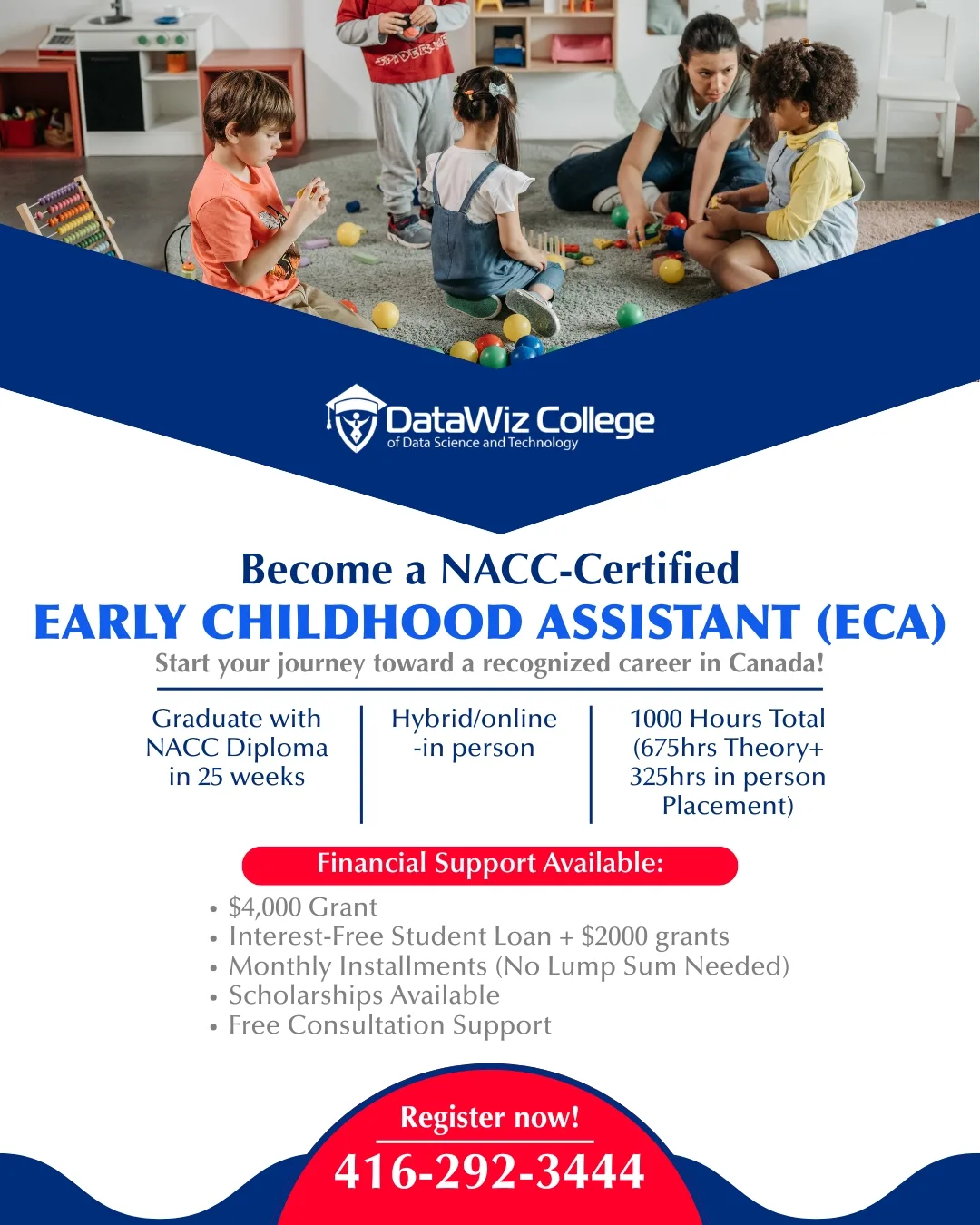
Financial Support Available
YOUR PROGRAM MAY COST LESS THAN YOU THINK
Eligible students may have access to a range of financial supports to help make the Early Childhood Assistant program more accessible. All options are subject to individual eligibility criteria and availability.
Grant — Subject to Eligibility
$4,000
Eligible students may qualify for a $4,000 grant to help offset the cost of the program. Grant availability and eligibility criteria apply.
Flexible Payments
No Lump Sum
Required
Pay in manageable monthly installments with no large upfront payment required to begin your program.
Merit-Based Awards
Scholarships Available — Subject to Eligibility
DataWiz College offers scholarships to qualifying students enrolled in the Early Childhood Assistant program. Scholarship availability, amounts, and eligibility criteria may vary. Contact our admissions team to learn about current awards and how to apply.
Please Note: All financial support options listed above are subject to individual eligibility criteria, funding availability, and applicable terms and conditions. DataWiz College does not guarantee access to any funding on behalf of any student. Registered as a career college under the Ontario Career Colleges Act, 2005. Programs approved as vocational programs under the Ontario Career Colleges Act, 2005.
Begin Your Early Education Career Journey
Enroll in the 25-weeks NACC Early Childhood Assistant Diploma Program today.
Live Online Event
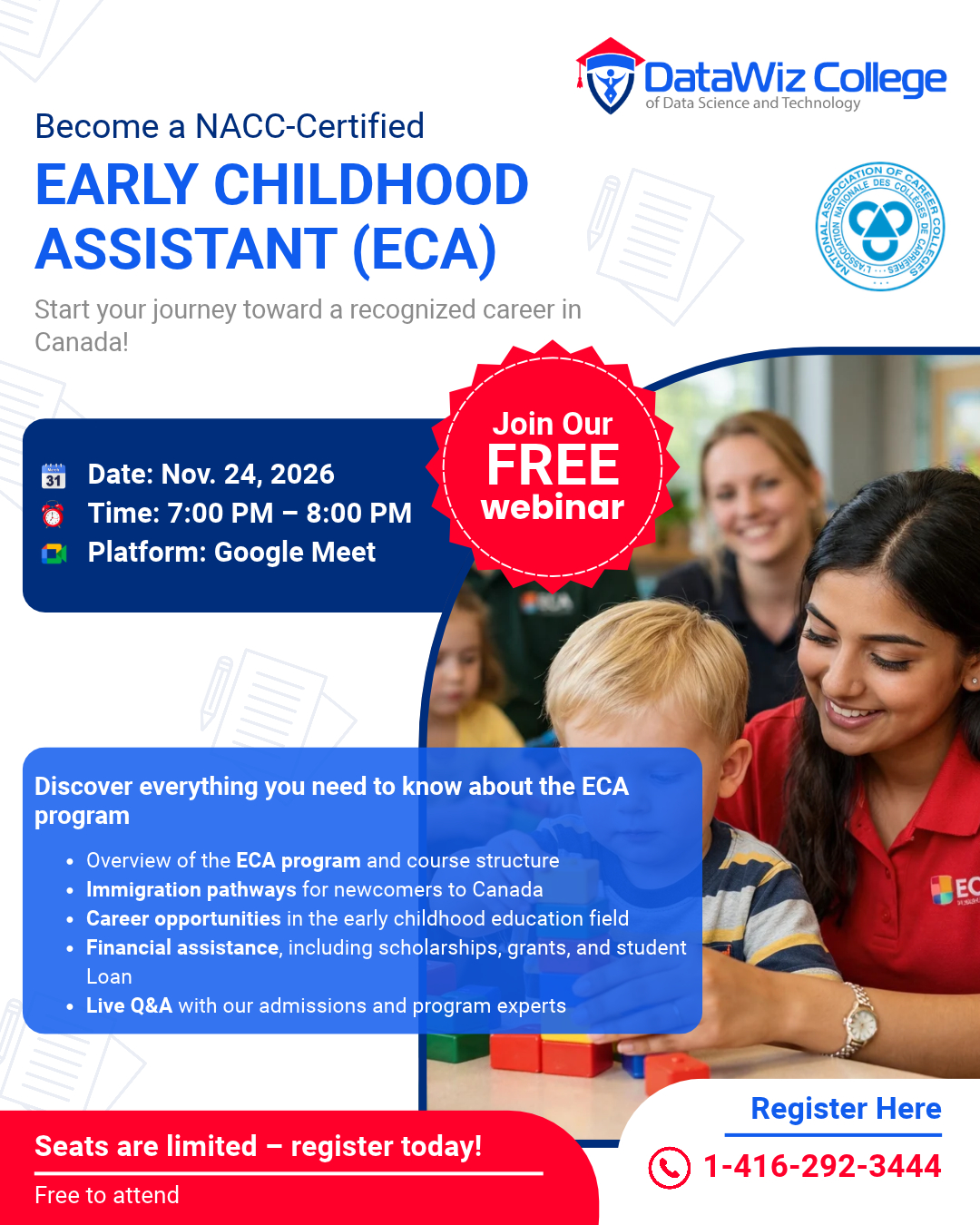
Join Our Free Webinar